Babel Was a Clue
Reading an AI encyclical for the small signal of a large, slow change
Magnifica Humanitas presents itself plainly enough. On May 25, 2026, the Vatican released Leo XIV’s first encyclical, “on safeguarding the human person in the time of artificial intelligence,” drawing on 135 years of Catholic social teaching from Rerum Novarum forward. Dignity, the common good, subsidiarity, solidarity, social justice. And a clue.
The clue is buried in two biblical metaphors: the Tower of Babel and Nehemiah’s rebuilding of the walls of Jerusalem. From the encyclical:
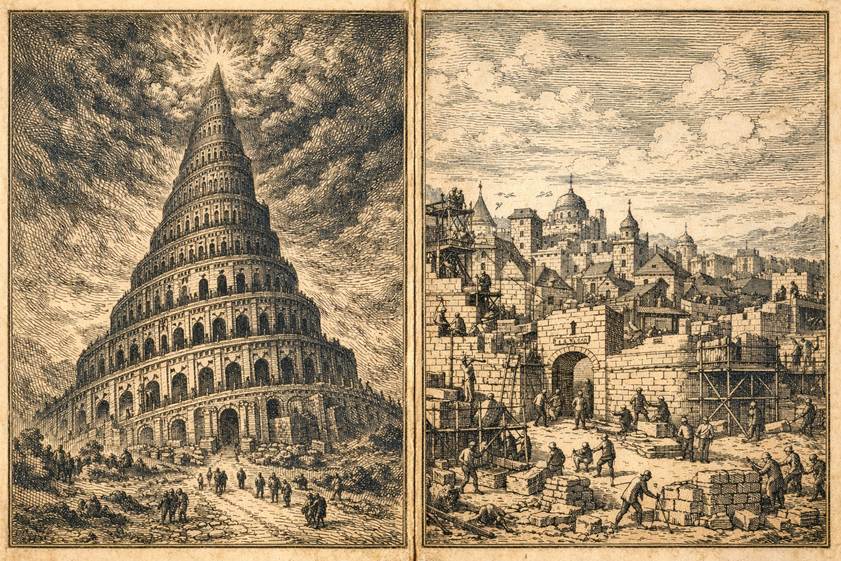
The story of Babel appears in the Book of Genesis… After settling in a plain in the land of Shinar, the people decided to build a city and a tower “with its top in the heavens” (Gen 11:4). Fearing being scattered across the earth, they sought to guarantee stability and power for themselves, and above all to “make a name” for themselves. It was an impressive feat: a single language, a single technology, a single direction. (§7)
Also from the encyclical:
Nehemiah convened the families, assigned each of them a section of the wall to rebuild, listened to their concerns, coordinated their efforts and addressed any opposition. The narrative shows how the city is reborn, not through the initiative of one man, but through the shared responsibility of all: men, women, priests, artisans, heads of households and young people all play a part. (§8)
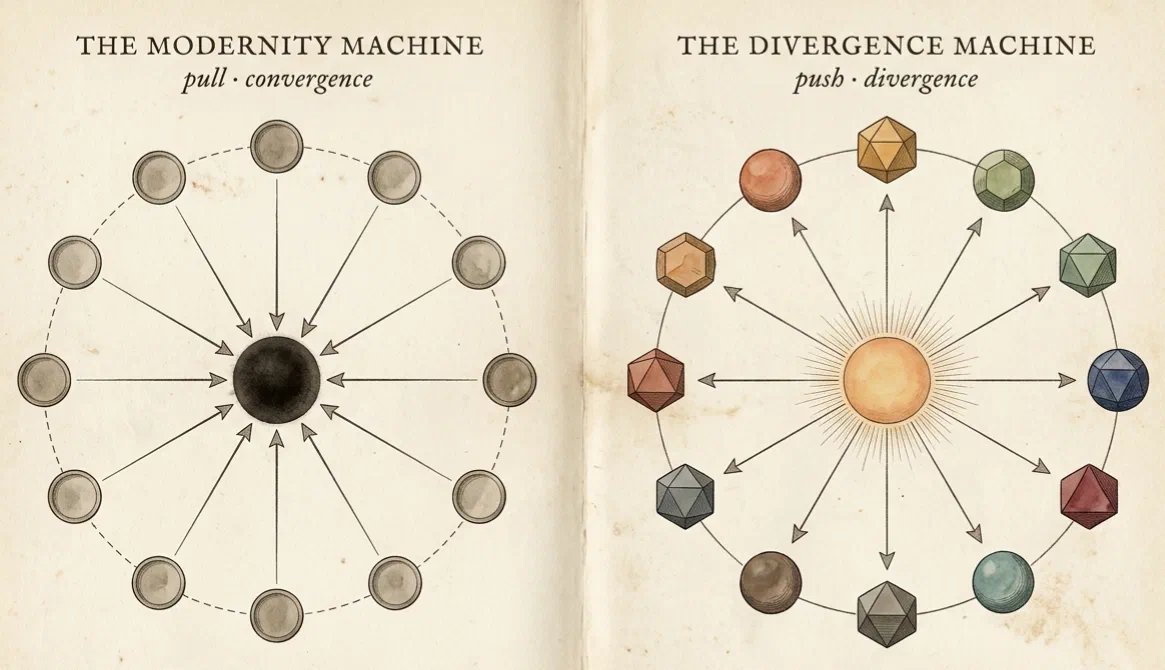
If you’re not seeing the clue, that’s because you’re not in the Contraptions book club this year. Our worldmachines.org historiography sets out long eras, called world machines, and we are living through the sunset of one (the Modernity Machine) and the dawn of the next (the Divergence Machine). The Modernity Machine is a pull system dragging everyone toward a single future — rationalization, material abundance, and scientific mastery — and calls the pull Progress. The Divergence Machine is a push system: it produces radically different outcomes depending on local conditions and admits no single destination, no one place we’re all headed. Convergence versus divergence; one future versus many.
Rather than these being a good-versus-evil contrast, the machines offer neutral visions of convergence and divergence. Applying this to the quotes: Babel is the Modernity Machine — one language, one direction, one goal. Nehemiah is the Divergence Machine — many hands, many voices, plurality that coheres without being flattened. The encyclical comes down against convergence, which I did not see coming from the Catholic Church.
So that’s nice and all, but so what? You can read the encyclical anywhere, and a hundred outlets will tell you what it says about AI. But the live question is stranger than that. What if the first important Catholic document of the AI age is not mainly about artificial intelligence, but about the exhaustion of convergence as a way of imagining the human future? If this reading is right, the encyclical is less a warning about technology than a sign that the Church may be repositioning itself after centuries of arguing with modernity on its own terms.
But why would the Pope open an AI encyclical with a distinction right out of our book club? Because…
Metaphors Come First
Metaphors come first, and arguments come second. A writer reaches for an image before the argument is settled, and then, across a long text, the argument shifts to inhabit the space the metaphor opens up. The metaphor carves the riverbed; the prose is the water that rushes in to follow its contours. Metaphors are often where historical reorientations appear first, on the level of intuition. Before institutions change their doctrines, they change their metaphors. And when the metaphor shifts from one tower to many households rebuilding a wall, it is worth asking whether something deeper than an AI policy debate is beginning to move.
We aren’t cataloguing divergence the way birdwatchers tick off species. We’re hunting the small early signals of changes that are big and slow — the kind that take centuries to fully arrive, and that are legible at the start only as a clue. World-machine shifts don’t announce themselves; they show up first as strange little mismatches. Babel and Nehemiah may be one of those mismatches. And I can’t help but notice that these metaphors are doing something real and generative: they do not merely restate the Church’s old suspicion of technocracy, but begin to sketch a more positive picture of plurality as the form of repair.
Describing AI, Leo says these systems are “more ‘cultivated’ than ‘built’” (§98). They are grown within a framework, not fully designed in advance, and for that reason even their makers “do not understand what they produce” (§99). The language here is biological. It presents AI as something that develops inside conditions and remains partly opaque even to the people who create it.
Seen this way, divergence runs through the document, not just through one opening contrast. The “rejected stones — the poor, the sick, the migrants” become “the cornerstone” (§16): the places the old machine filed as errors are exactly where Leo builds.1 His verb for what to do with AI is “to disarm,” which he glosses as “restoring it to the plurality of human cultures and ways of life” (§110).
Someone will object before you finish the sentence: this is just metamodernism. In our framework’s telling, metamodernism is modernity that cannot mourn itself — a backward-looking structure of feeling that reaches for re-enchantment and sincerity precisely because the Progress it still wants has stopped arriving.2 On that reading the encyclical looks like a textbook case: re-enchantment, the meaning crisis, the nostalgia that wants what modernity used to deliver. Subsidiarity becomes decentralized modernity, or federalism with incense. This objection frames the encyclical as late-modernity presenting itself as a new era. And much of it is exactly that. But not those metaphors. The metaphors are the part of this document that is alive3 — and they are doing more work than the document quite needs them to.4
Apophatic Machines
When describing AI itself, the encyclical takes an almost apophatic approach. It repeatedly tells us what AI is not. It is not wisdom. It is not judgment. It is not responsibility. It is not relationship. It is not dignity. The document spends surprisingly little time defining artificial intelligence positively and a great deal of time tracing its boundaries. Not this. Not that. Not this either.
The effect is curious. Every limitation assigned to AI throws the human person into sharper relief. Negative theology traditionally approached God through negation, describing what could not be said. Leo uses a similar structure to illuminate humanity. By saying what AI cannot be, he gradually reveals what he believes a person is.5
The encyclical anchors this revelation in two specific claims. First, humanity as embodied incarnation — the “wounded yet beloved flesh” (§231), the body as “a dwelling place of God and a temple of the Holy Spirit” (§239). Second, humanity as being made in the likeness of God — dignity as a gift that “precedes and transcends each person” (§50). You are a body, and you are an image.6 That is what the document is defending when it defends the human. And there’s something quietly strange about needing to say it at all.
It is weird that this seems weird. An institution stands up and says: you are embodied, you are made in the image of God, and that is the ground that no optimizer can touch — and in 2026 this reads as a contrarian, almost eccentric position rather than a banal one. The water we swim in has shifted far enough that you are a sacred body now lands as a provocation. If our threshold for the “weird” continues to shift, that drift is the machine in motion — and we are catching the signal early.
On the Back Foot
Now let’s zoom out. For the entire run of the Modernity Machine, the Church has been on its back foot. It opened with the Counter-Reformation: a convergence project (Trent, the Index, centralization) — the most successful parts of which were aesthetic: Bernini, the Baroque. Beauty as a counter-modern media strategy.
Centuries later, Vatican II tried a different adjustment. It made a structural turn toward divergence — shattering the single language of Latin into a plurality of local vernaculars — but in the process, it largely discarded that Counter-Reformation spirit of beauty. It has been a centuries-long sequence of accommodations, all of them made from inside the pull system. A turning point came when the Church codified a long-held instinct — subsidiarity was named in Leo XIII’s Rerum Novarum (1891) and “systematically formulated” by Pius XI in 1931 (§31) — barely a hundred years ago.7 It is a push-shaped principle.8
One more metaphor to dwell on: “Promethean dreams” (§128). It would be easy to read this as the Church selecting a new enemy. I think that misses how the metaphor is working. Promethean dreams function as a contrast agent, not a target. They make the human person visible. The Promethean dream is the dream of the technocratic paradigm. But the encyclical keeps returning to bodies, relationships, and communities. The point is not merely that technology should be used responsibly. It is that the human being cannot be fully understood in technological terms.
Leo may even have a bit of a blogger’s instinct here. The encyclical arrives wrapped in AI because AI is what everyone wants to discuss. But the deeper subject is Catholic social teaching itself: dignity, subsidiarity, solidarity, embodiment, and the common good. AI supplies the sizzle. The social doctrine is the steak.
(I know, I know. Anyone who actually grew up Catholic like me will immediately point out that the Church is not exactly famous for its uncomplicated, joyful view of the body. But institutions contain multitudes, and epochs rewrite priorities.)
I’m not claiming this is the future of the Catholic Church. Things this size start far too small for anyone to claim that. The response to modernity has run for four centuries and is still running. But if something new is beginning inside it, it goes deeper than a new target. The institution is reconstituting itself for the next four-hundred-year era.
There may even be a future hiding in the anti-“Promethean dreams” stance: as the digital world grows more powerful, it may also grow less interesting, and the things we find meaningful drift back toward the physical. Re-centering human life in the given world would be quite the de-dramatizing move. Though there I’m running ahead of the clue.
What Babel/Nehemiah lets us glimpse is a possible direction. A metaphor can take an institution somewhere it never meant to go. Whether this one does, we won’t know for a long time. It is precisely the kind of small, slow clue this book club exists to catch.
In the book club’s shorthand, we call this dynamic the bugspace/feature-space flip: the bugspace of the Modernity Machine becomes the feature space of the Divergence Machine. ↩
I’m taking this characterization of metamodernism from the “Metamodernity” section of Venkatesh Rao’s The Divergence Machine (the 2026 book-club kickoff), where it figures as a late, backward-facing current rather than a forward one — modernity’s afterglow, not its successor. Stating the objection in the framework’s own terms is the point: a strawman metamodernism would be cheap to knock down and prove nothing. ↩
The early criticism has mostly come from the other direction — that the encyclical is too socialist, or reads like a European bureaucrat’s wishlist (procedural safeguards, GDP-beyond metrics, “transparency and accountability” by the paragraph). On our terms that criticism is half right, but mislocates the problem. Those passages are indeed the weakest in the document. They consist of dead, convergence-flavored proceduralism — the machine’s own language borrowed to police the machine. The life in this encyclical isn’t in its policy. It’s in its metaphors. The critics and I are pointing at the same paragraphs and drawing opposite conclusions about why they fall flat. ↩
Worth being precise about what “alive” is doing here. In the framework a live element is generative — it opens pathways, recombines, points past itself — where a dead one merely administers or preserves. By that test most of the document’s prose is administrative and much of its imagery is generative, which is the whole tension this essay is pulling on. ↩
To be clear, I’m decidedly not comparing AI to the Almighty. The point is structural, not theological: defining a thing by what it is not — the via negativa — is a mode of reasoning the Church has run for well over a millennium, back through the apophatic tradition to Pseudo-Dionysius in the fifth or sixth century. Leo is just pointing the old apparatus at a new object. ↩
The pairing is older than it looks. In the Aristotelian-Thomist grammar the Church reasons in, body and image aren’t two attributes bolted onto the human; they are matter and form — the body the materia, the imago Dei something like the forma that makes the matter a person rather than a mechanism. Hylomorphism is the technical name. ↩
Pius XI, Quadragesimo Anno (1931), is where subsidiarity receives its canonical formulation; the deeper root is Leo XIII’s Rerum Novarum (1891), the document this encyclical is consciously written in the lineage of. The dating carries weight in the argument: a roughly hundred-year-old principle surfacing now is a far more legible clue than some timeless Catholic preference for the local, which is what a looser telling would imply. ↩
The encyclical shows you the tempo itself. Its section on slavery calls the Church’s long complicity “a wound in Christian memory” and, “in the name of the Church,” asks pardon (§176), noting that slavery’s “full incompatibility” with the faith took eighteen centuries “to be explicitly recognized.” Same slow-motion pattern: not new doctrine replacing old, but a truth formally held becoming a social reality the institution could finally see. If it can take eighteen centuries to fully see one of its own commitments, a hundred-year-old instinct surfacing in a metaphor is exactly the size and speed of clue to expect. ↩